Repairs · Burlington
Garage Door Safety Inspection
During the power outage you pulled the red cord and tried to lift the door by hand. It felt like lifting a piano, and when you let go part-way it sank back toward the floor on its own.
Garage Door Safety Inspection
In plain words
For a home you have just bought, or one you are about to sell, the inspection gives the door a starting point. The report records the door and opener models, the spring type, the condition of every wearing part and the results of the balance and safety tests, all against a date. Anything that needs attention is listed with a suggested order. From then on you have something to compare against: a noise that appears next year means something changed since the record, not a mystery, and a buyer or an insurer asking about the door gets a factual answer instead of a shrug.
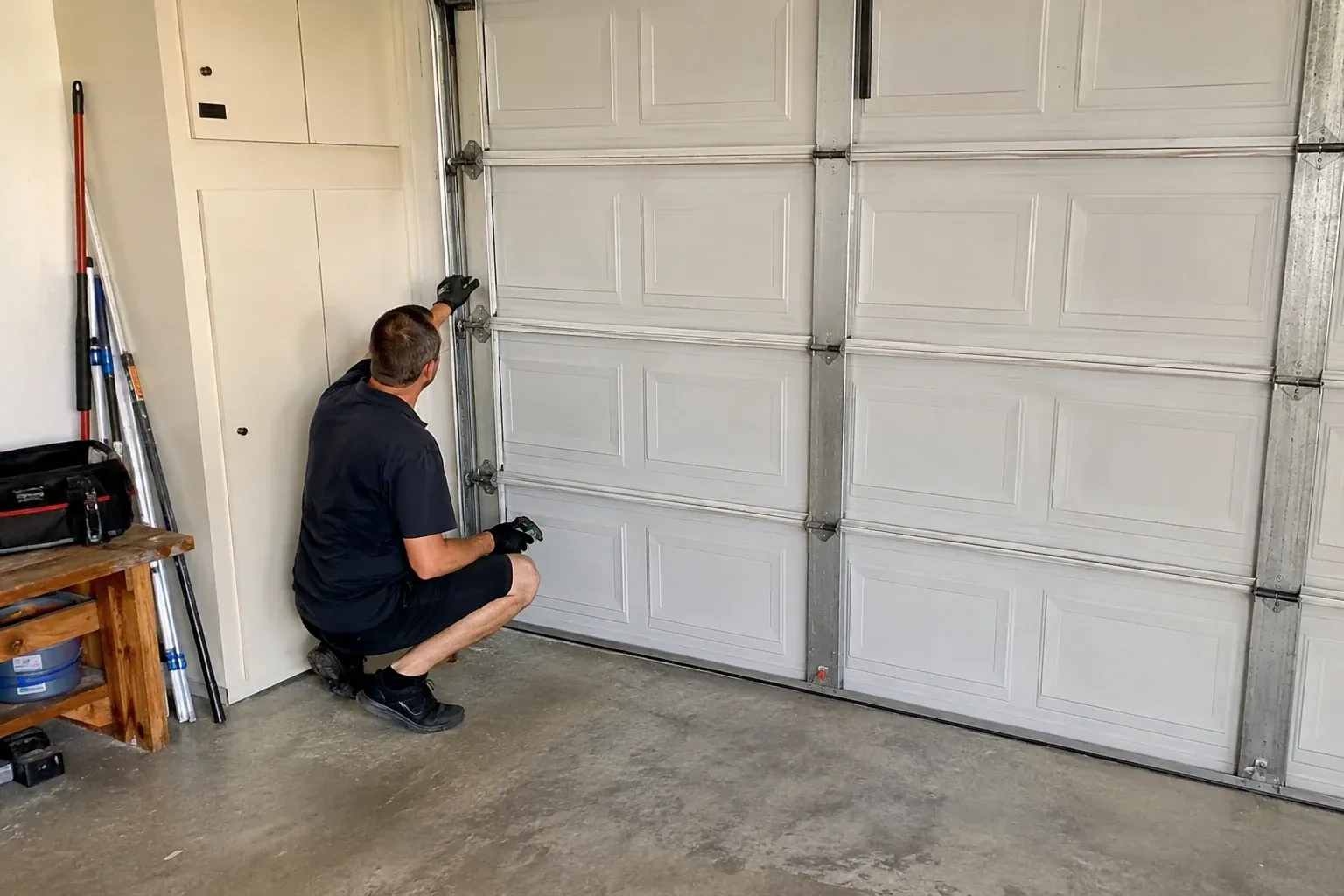
How the visit goesA tenant mentioned the door is louder than it used to be. From the driveway it looks fine, but on closer inspection the hinges near the floor are streaked orange and one roller wobbles as it turns.
Burlington
How the visit goes
Springs, cables and drums, looked at and left alone
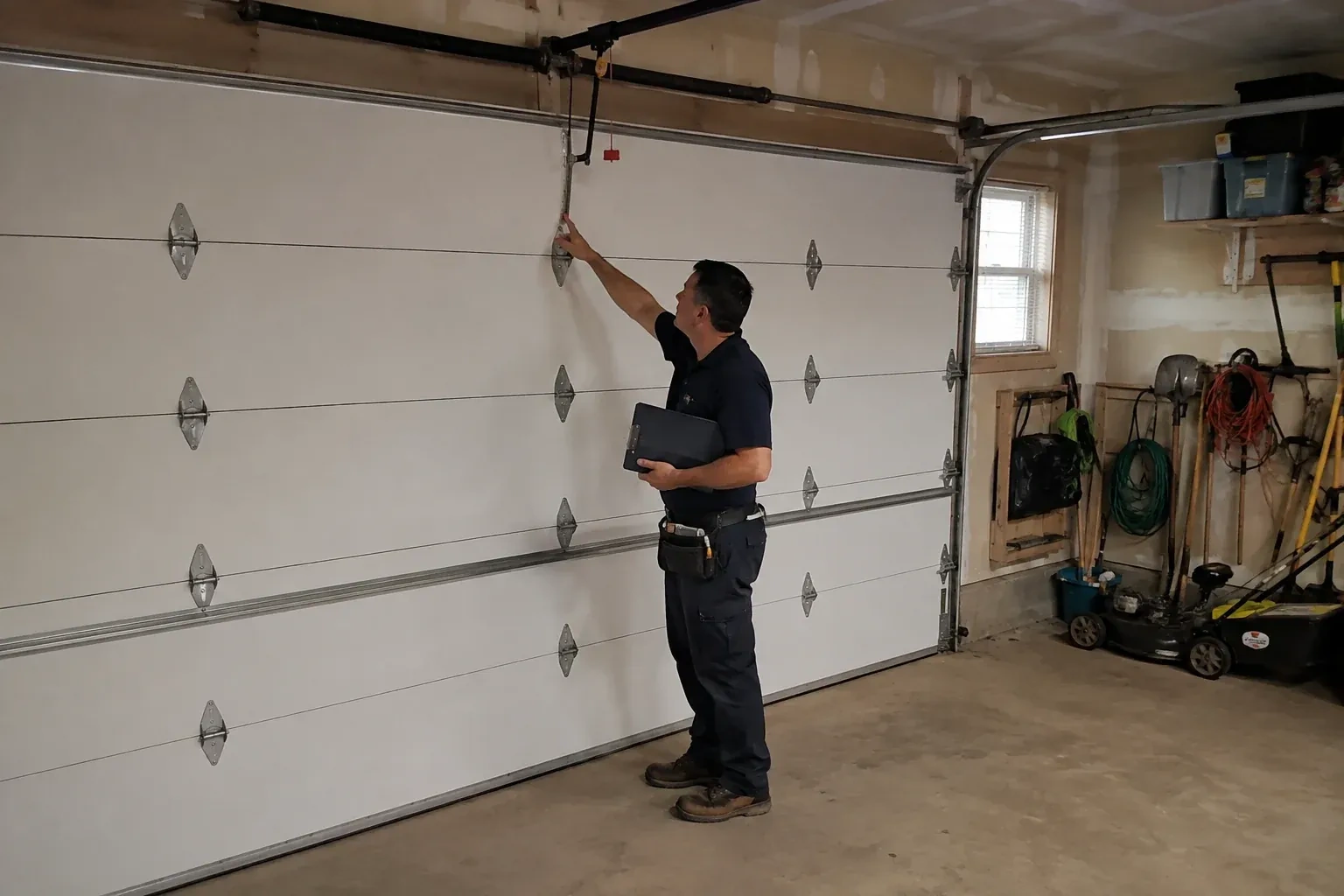
The counterbalance gets a careful look and nothing more during the inspection. On a torsion door the technician checks the spring coil for a gap, rust or a stretched section, confirms the cone set screws and centre bearing look sound, and follows each cable from the drum to the bottom bracket looking for broken wires, a rust bloom near the loop or a slack side. The drum wrap is checked for a single neat layer. On an extension door the springs, pulleys and containment cables are examined the same way. Any adjustment to these parts is a separate, planned job matched to that system, torsion tension controlled with winding bars rather than simply released; the inspection records their condition.
Controls, release and lock
Each way of operating the door is tried in turn: the wall control, every remote the household uses, the keypad if there is one, and the lock or vacation button that disables the remotes. The technician checks that the wall control is mounted out of a small child's reach and within sight of the door, that batteries are fresh, and that the manual release cord hangs within reach with its handle intact and releases and re-engages the trolley cleanly. Any manual slide lock on the door is checked to make sure it is disengaged, since a door locked by hand while the opener is connected is a common cause of a bent rail.
A dated record you can keep with the manuals
You leave the visit with a written report tied to a date, the door and opener model numbers, and the technician's name. It lists what was in good order, what was maintained on the spot, what is worth planning and, if anything, what must be corrected before the door is used. Measurements and photographs sit alongside the findings so a future repair can be quoted from the record and a future inspection can show what changed. Keep it with the door's manuals or in the home file. It is the kind of document that answers a buyer's question, an insurer's question or your own question in a year's time in one page.
Garage Door Safety Inspection
In the van
- Tape measure and level
- Flat 2x4 test board
- Camera for findings
- Spring and cable gauges
- Replacement hinge and track fasteners
What affects the quote
Same fees day, night or weekend
1How many doors are on the property
Each door and opener gets its own inspection and its own record. Two doors in one visit share the travel, but the checks are done in full on both.
2Distance to the property
Travel is part of every visit. A property across town and one at the end of a rural road involve different driving time, and the quote reflects the trip.
3Opener type and age
A current opener with photo eyes, a keypad and several remotes has more devices to test than an older unit with contact reversal alone, and the test procedures differ by model.
Garage Door Safety Inspection: questions
What are photo eyes, and how are they tested?
They are the two small sensors low on each side of the opening, one sending a beam and the other receiving it. The technician confirms both indicator lights hold steady, that the units sit at the height the opener maker specifies, and that the lenses are clean and the wiring secure. Then a close cycle is started and something is passed through the beam; the door should reverse. Misalignment or a grimy lens is corrected on the spot.
Can I do these checks myself between visits?
The three owner checks, yes: the manual balance test from the closed position, the board test for contact reversal and the photo-eye test with a broom handle through the beam. Industry guidance recommends all three monthly. What stays with a technician is anything that involves loosening, winding or unhooking springs, cables, drums or bottom brackets, and any adjustment to the opener's force settings.
Is the inspection different for an older detached garage with springs along the tracks?
The route is the same and the counterbalance looks different. Extension springs stretch beside the horizontal tracks and pull through pulleys, so the technician examines each spring for stretch and a broken end, each pulley for a grooved wheel or a seized bearing, the cable clips, and whether a containment cable runs through the centre of each spring. Balance, reversal and photo-eye tests are unchanged.
Repair & Maintenance
- Off-Track Garage Door ResetThere was a loud bang from the garage, then silence.
- Garage Door Panel ReplacementThe top section has developed a bend where the opener arm pulls on it.
- Garage Door Bottom Seal ReplacementWith the door closed and the lights off, a bright line of daylight runs along the floor from one…
Garage Door Safety Inspection near you
We think of garage door work in Burlington as keeping a heavy moving object safe and smooth. That covers spring and cable work, tracks and rollers, opener force and sensor settings, seals against the weather, and complete door replacement when a repair no longer makes sense.