Springs · Burlington
Extension Spring Replacement
It is the first hard frost of the year and the door on the old detached garage has stopped halfway, squealing at one pulley. The springs are the ones that came with the door decades ago, orange with rust where they hang near the back wall.
Extension Spring Replacement
In plain words
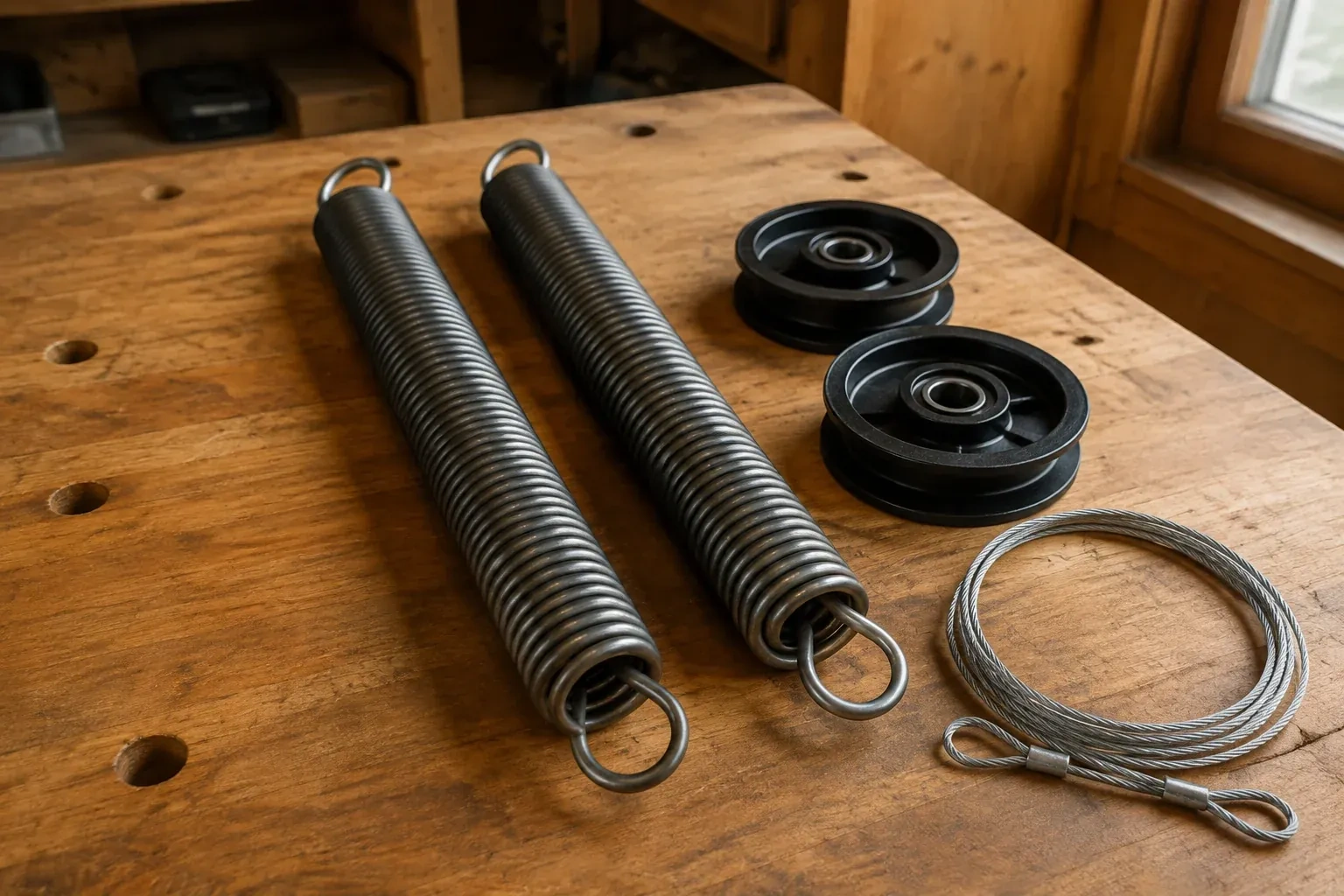
Extension springs are the two long coil springs that run beside the horizontal tracks of a garage door, one on each side. They stretch as the door closes and pull back as it opens, and that pull is what makes a heavy door feel light. Replacement puts a new, matched pair on the door. The technician opens and secures the door so the springs are slack, removes the old set, fits springs rated for the door's actual weight with containment cables through their centres, threads the lift cables over the pulleys, and adjusts both sides until the door balances. The opener is reconnected and tested last.
How the visit goesThe home inspector's report on the house you are buying flags the garage door: extension springs with no safety cable running through them, coils showing rust, and a door that sank when he lifted it partway. The seller has never had it looked at.
Burlington
How the visit goes
Pulleys, cables and the hooks that set them
Each side of an extension system has two pulleys, one on the moving end of the spring and one fixed at the front of the horizontal track, and a lift cable that runs from the bottom bracket over both to an S-hook or clip on the track hanger. Each pulley is spun to feel for a rough bearing and looked at for a wheel worn to a sharp groove or wobbling on its bolt. The cables are followed for fraying, rust at the bottom loop and a wrap that has slipped off a pulley. Worn pulleys and cables are renewed with the springs, since a seized pulley is often what shortened the old spring's life.
Taking the old springs down
With the door open and clamped, each old spring is nearly slack, and removal is straightforward. The technician unhooks the lift cable from its S-hook or clip at the front, which lets the spring's pulley end drop free, then lifts the rear loop off the hanger. The old containment cable is unclipped from its anchors and pulled out of the coil. On a door with a broken spring, the two halves are gathered and the containment cable, if there was one, is inspected for the marks of having done its job. Everything that comes down is laid out on the floor so the old spring can be measured against its replacement and you can see the wear.
A clear threshold and an honest opener
Two habits protect the new springs from the shocks that shorten a spring's life. The first is the floor: a door that comes down on a bin, a bike wheel or a ridge of packed snow stops short while the springs and cables are still pulling, and the jolt can throw a cable off its pulley. Keep the opening clear and scrape the ice ridge off the threshold before running the door in winter. The second is the opener's force setting. It was set for the newly balanced door; if the door ever seems to need more push, that is the springs asking for attention, not a reason to turn the force up.
Extension Spring Replacement
In the van
- Rear spring hangers and angle iron
- Garage-door spray lubricant
- Lag screws and hanger bolts
- Containment (safety) cables
- Door-weighing scale
What affects the quote
Same fees day, night or weekend
1Rollers, hinges and bottom brackets found worn
Cracked roller wheels, split hinges or a bottom bracket rusted at the cable pin are pointed out during the inspection and offered as optional items, since the door is already open and secured.
2Track or section damage found on the way
A bent horizontal track, a bracket pulled off the jamb or a top section twisted by running the opener on a broken spring is separate repair work, quoted on its own.
3Converting to torsion instead
Where the garage has the headroom, some owners take the opportunity to move to a torsion system. That is a different job with different hardware and is quoted as its own option.
Extension Spring Replacement: questions
Would a stronger spring make the door easier to lift?
Not in a useful way. The aim is a spring that matches the door's weight, so the door holds still wherever you leave it. A spring rated above that weight pulls the door up on its own, makes it hard to close, and leans on the opener to hold it down. A spring rated below lets it sink. Matched springs, set to the same hook position, give the light, even feel you want.
I added insulation and windows to the door. Does that affect the springs?
Yes, and it is one of the more common reasons a pair of springs is suddenly found wanting. Insulation panels, glazed sections, a wood overlay or a new steel skin all add weight the original springs were never chosen for, so the door grows heavy and the opener strains. When the springs are replaced, the door is weighed as it is now, and the new pair is rated for the door you actually have.
How do you know which springs my door needs?
By weight. Extension springs are rated for the weight they lift, so the technician releases the opener and weighs the door on a scale, then matches that figure and the door's height to a spring rating and stretch length. The old springs are measured as a check on wire size, coil diameter and length. Where the two disagree, the scale decides, since doors gain weight from added insulation or panels.
Springs & Hardware
- Garage Door Hinge ReplacementThe car nudged the door on the way in.
- Garage Door Track Repair or ReplacementYou bought the house with a door that sticks near the top of its travel.
- Garage Door Cable ReplacementYour older door has springs along the tracks, and one cable has slipped off its pulley and dangles…
Extension Spring Replacement near you
We think of garage door work in Burlington as keeping a heavy moving object safe and smooth. That covers spring and cable work, tracks and rollers, opener force and sensor settings, seals against the weather, and complete door replacement when a repair no longer makes sense.