Openers · Burlington
Garage Door Opener Replacement
The remotes only work from the end of the driveway now, and one of them disappeared with a set of keys last month. Inside the remote are tiny switches instead of a learn button, so excluding the missing one means resetting the switch pattern on every remote…
Garage Door Opener Replacement
In plain words
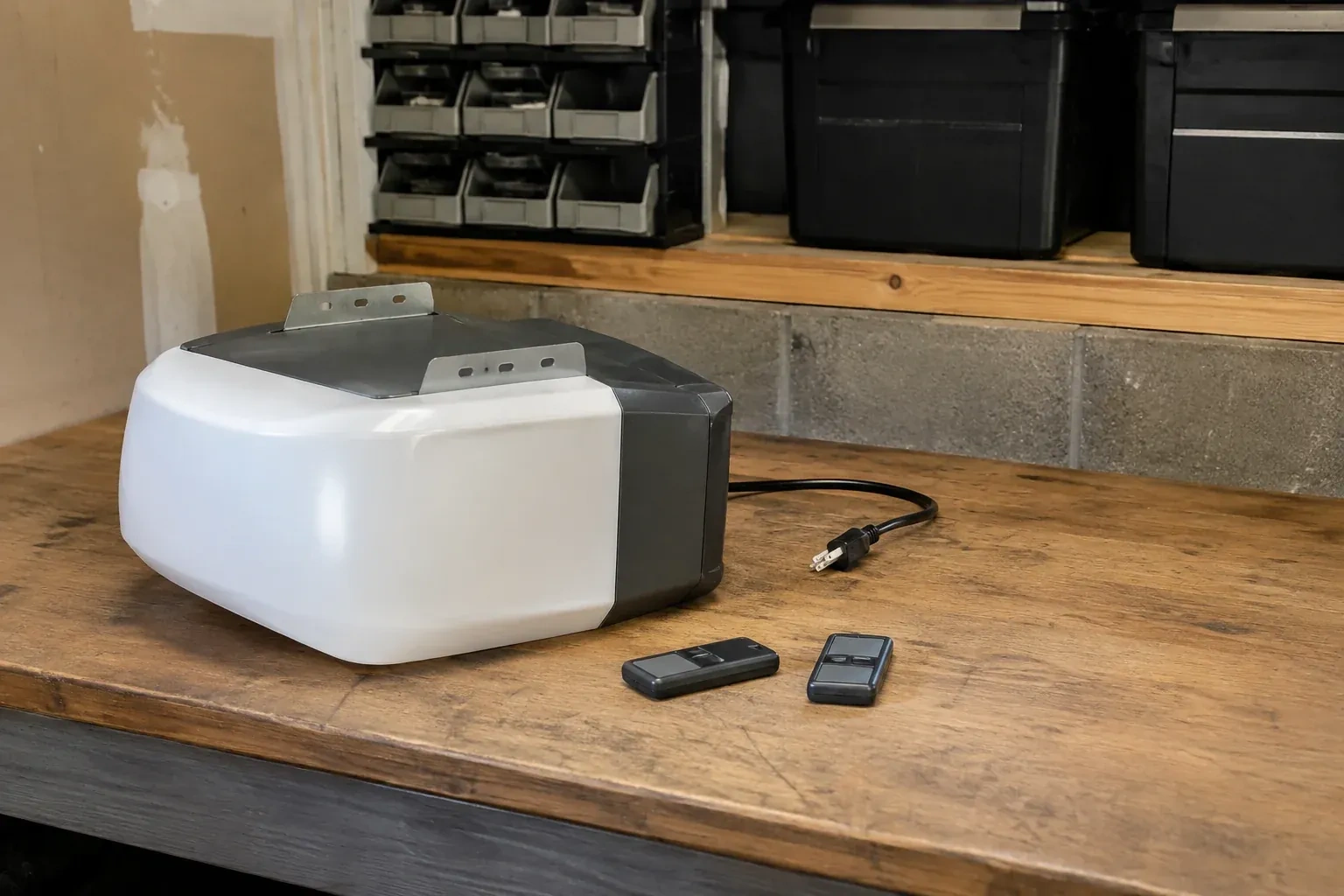
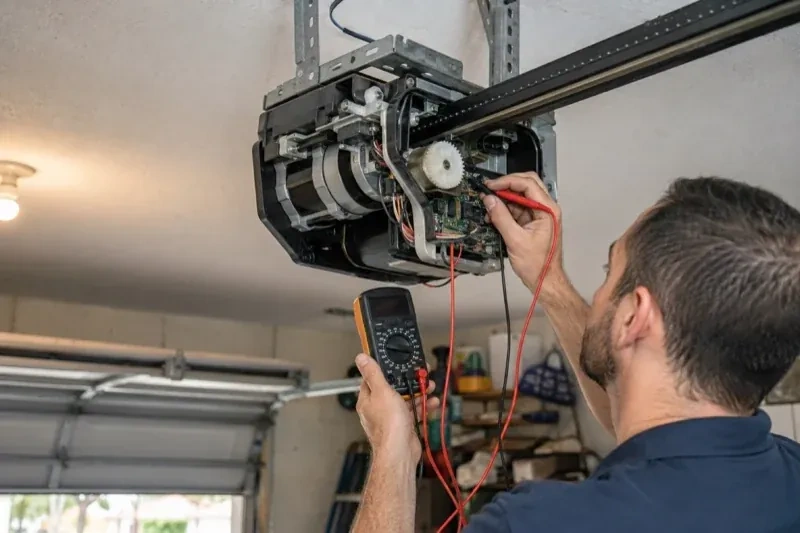
Here is what the day looks like. The technician arrives, watches how the door behaves, then unplugs the old unit and tests the door by hand. Once balance is confirmed, the old head, rail, sensors and control come down and the new rail is assembled on the floor. The header bracket goes into solid framing above the door, the head is hung level from the joists, the door arm and reinforcement are fitted, and the sensors and wall console are wired. Travel, force and safety tests follow, then programming of remotes and keypad. Allow a morning or an afternoon, and a little longer if door work is added.
How the visit goesThe remotes only work from the end of the driveway now, and one of them disappeared with a set of keys last month. Inside the remote are tiny switches instead of a learn button, so excluding the missing one means resetting the switch pattern on every remote and the receiver.
Burlington
How the visit goes
Headroom, framing and where the rail will hang
Looking up tells the technician how the new opener will fit. The gap between the top of the open door and the ceiling decides whether a standard rail has room or a low-headroom arrangement or a wall-mount operator is the better fit. The wall above the door is checked for solid framing to take the header bracket, and the ceiling for joists or trusses to carry the angle iron that hangs the head. Door height matters too: a 7 ft door takes a standard rail while an 8 ft door needs an extension. Storage racks, lights and ducts in the path of the rail are noted so nothing gets in the way on the day.
Building and hanging the new rail
The rail sections are joined on the floor, the trolley is threaded on and the chain or belt is fitted and tensioned to the maker's setting before the assembly is bolted to the head. The header bracket is fastened with lag screws into solid framing centred above the door, high enough to clear the top section at the highest point of its travel. The head is then raised, hung from the ceiling joists with perforated angle iron cut to length, and adjusted until the rail runs level and in line with the door's centre. A rail that is true to the door keeps the trolley from binding and keeps the drive quiet for its whole life.
A record of what is in your ceiling
Before leaving, the technician hangs the operator manual and the door manual near the wall console, where the industry expects them to live, and notes the model and serial number for you. You are shown the warning labels that belong on the wall by the console and on the door itself, how the light and lock buttons on the console behave, and how to read the indicator lights on the photo eyes. If an app was set up, the account details stay with you. All of this makes any future service call a short conversation, and it means whoever buys the house one day inherits a system they can understand.
Garage Door Opener Replacement
In the van
- Door arm and door bracket
- Top-section reinforcement strut
- Photo-eye sensors
- Wall control console
- Rail sections and trolley
What affects the quote
Same fees day, night or weekend
1Ceiling height and mounting
A head unit hung from a high or cathedral ceiling needs longer angle iron and more time on the ladder than one mounted under a standard joist, and a finished drywall ceiling takes more care to fasten into.
2Top-section reinforcement
Lightweight steel, glazed and wide doors need a strut or operator bracket across the top section before the arm is attached, so the pull is spread across the door rather than concentrated at one point.
3Door work found during the balance check
Spring adjustment or replacement, tired rollers, cracked hinges or frayed cables discovered when the door is lifted by hand are quoted as door work in their own right, never folded into the opener.
Garage Door Opener Replacement: questions
How many remotes and keypads can be added?
Capacity depends on the model: current operators hold anywhere from about eight to forty remote codes, so most households can pair every driver, a keypad, in-car buttons and a phone with room to spare. Remotes are added by holding the learn button on the head unit and pressing the remote; the console guide shows the steps and the technician leaves them written down. If a remote is lost later, clearing the memory and re-teaching the others takes only a few minutes.
Should an opener from before the mid-1990s be replaced rather than repaired?
Manufacturers recommend replacing units made before 1993, since most lacked external entrapment protection such as a photo-eye pair, a sensing edge or a constant-contact close control. Identify the model rather than guessing its age or remote type, since a fixed-code remote with small switches is not proof by itself. Replacing rather than repairing brings the sensor beam, a contact-sensitive force setting, remotes whose code changes on every press and a console lock button.
Can the new opener use my old rail?
The rail, trolley and drive are designed as one system with the head unit, so a new operator comes with its own rail matched to its motor and drive type. Reusing an old rail would mix parts that were never meant to run together. The old rail, head and hangers come down and are recycled, and a fresh rail is assembled to suit your door's height.
Openers & Access
- Chain-Drive Opener RepairHalfway up, the door lurches.
- Belt-Drive Opener RepairHalfway up, every single time, the door hesitates and there is a ratcheting sound from the motor…
- Photo-Eye Sensor Alignment or ReplacementThe door will only go down while a finger stays on the wall button; let go and it stops or reverses.
Garage Door Opener Replacement near you
We think of garage door work in Burlington as keeping a heavy moving object safe and smooth. That covers spring and cable work, tracks and rollers, opener force and sensor settings, seals against the weather, and complete door replacement when a repair no longer makes sense.