Openers · Burlington
Chain-Drive Opener Repair
Halfway up, the door lurches. Something in the drive skips a beat, the chain jumps, and the door finishes its travel with a jolt.
Chain-Drive Opener Repair
In plain words
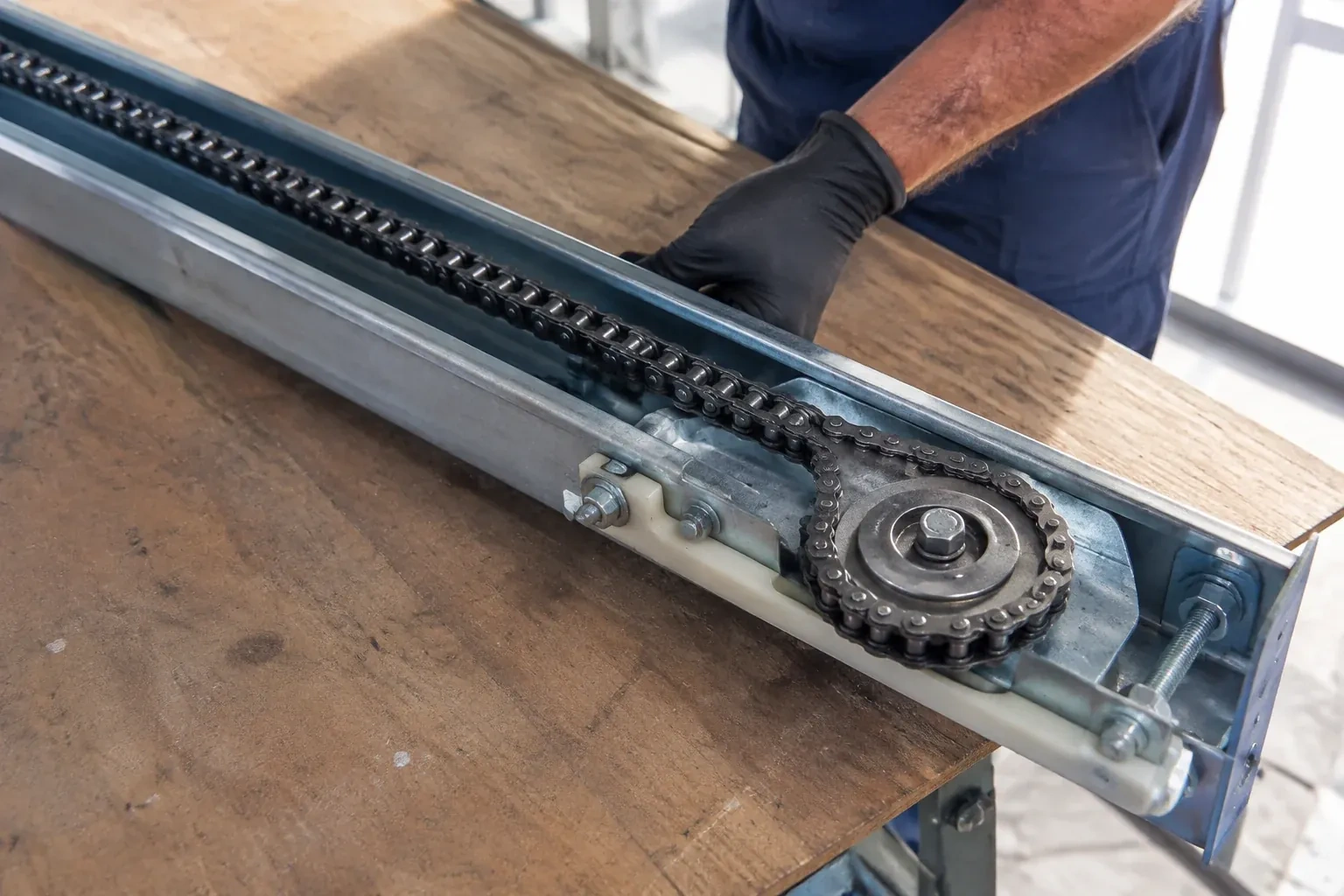
A chain-drive opener moves your door with a steel chain that runs along a rail from a sprocket on the motor head to a trolley hooked to the door arm. The technician first confirms the door is balanced, since the chain only guides a door the springs already carry. Then the chain is checked for stretch and rust, the sprocket and the gear behind it for worn teeth, the trolley and its release for wear, and the rail and hangers for movement. Whatever has failed is replaced with parts made for that model, tension and limits are set, and the safety reversal is tested.
How the visit goesThe rail shakes when the door runs. The steel straps holding it to the ceiling have worked loose, the chain rattles the length of the garage, and a bolt has already dropped onto the hood of the car.
Burlington
How the visit goes
Rail, hangers and the bracket in the wall
The rail is a structural part of the drive, and a chain cannot run true on a rail that moves. The technician checks that the perforated angle iron hanging the head from the joists is tight and stiff, that the rail is level along its length and angled slightly down away from the header, and that the splice plates at the rail joints are snug. The header bracket above the door is checked for lag screws that have loosened in the wood, which lets the whole rail lift a little on each cycle and shows as a rattle along the garage. Loose hardware is tightened or replaced before tension is set, since a flexing rail makes the measurement meaningless.
Resetting travel and force
With the drive mechanically sound, the operator is taught the door again. On older heads, the up and down limit screws are turned with a flat screwdriver, each full turn moving the stop about 5 cm, until the door meets the floor with the seal lightly compressed and opens to full height without the trolley reaching the bolt. Force is set to the lightest level that moves the door reliably through a full cycle in the garage's normal temperature. Newer heads run a learn cycle from buttons on the back and measure both for themselves. The operator is then cycled several times to confirm the settings hold.
Grease where it belongs, and nowhere else
The rail was cleaned and given a thin coat of white lithium grease where the trolley runs, on the schedule that opener's own manual calls for, often every two or three years, with the old grease wiped away first. The gears inside the head were packed with the same grease and need nothing between services. The chain itself is treated only as the maker's manual directs, often not at all, since heavy oil collects grit and drips on the car. Rollers, hinges and bearings on the door take a garage door lubricant once a year. The tracks the rollers run in take none, and penetrating sprays stay away from the whole system because they strip grease from gears.
Chain-Drive Opener Repair
In the van
- Cold-rated garage door lubricant
- Drive gear and worm gear kit
- Inner and outer trolley
- Roller chain with master link
- Chain tensioner nuts and shaft
What affects the quote
Same fees day, night or weekend
1Rail shape and door height
A T-rail and a square rail take different chains and tension figures, and an 8 ft door runs a longer rail and chain than a 7 ft door, so the length of chain on the quote follows the rail.
2Age of the operator and parts supply
Parts for recent heads are on the van; parts for a unit several decades old may need ordering, and where a maker no longer supplies them the conversation turns to what can be done instead.
3Two operators in one visit
A double garage with two chain drives, or a house and a detached workshop, share the travel and setup and are quoted as one visit with two repairs.
Chain-Drive Opener Repair: questions
Should I use the slide lock on the door with a chain drive?
No. The manual slide lock on the door is disabled or removed once an operator is connected, and the technician checks that during the repair. A motor pulling against a locked door strains the chain, strips the drive gear and can bend the top section of the door. If you want the door secured against remotes, the lock button on the wall control switches them off, and a track lock designed to work with an operator does the rest.
Can you turn the force up so the door closes on cold mornings?
Force is set to the lightest level that moves the door reliably, and it is raised only a little for a cold garage. Turning it up further to overcome a heavy door or a seal frozen to the slab is not done, because too much force interferes with the safety reversal and can bend the top section. If the door is hard to move in the cold, the springs, rollers or the frozen seal are dealt with instead.
How much slack should the chain have?
It is a measurement, taken with the door closed and disconnected from the trolley. At the middle of the rail the chain should sit at the height the opener's own manual specifies for its rail shape, since the figure is not the same across makes. The two nuts on the trolley set and lock it. With the door reconnected and closed, some droop appears; that is expected as long as the measurement returns when the door is open.
Openers & Access
- Belt-Drive Opener RepairHalfway up, every single time, the door hesitates and there is a ratcheting sound from the motor…
- Garage Door Opener ReplacementThe remotes only work from the end of the driveway now, and one of them disappeared with a set of…
- Photo-Eye Sensor Alignment or ReplacementThe door will only go down while a finger stays on the wall button; let go and it stops or reverses.
Chain-Drive Opener Repair near you
We think of garage door work in Burlington as keeping a heavy moving object safe and smooth. That covers spring and cable work, tracks and rollers, opener force and sensor settings, seals against the weather, and complete door replacement when a repair no longer makes sense.